The Clash by Martin Popoff
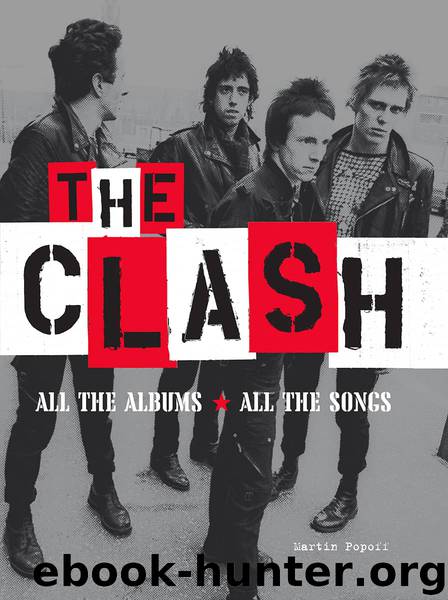
Author:Martin Popoff
Language: eng
Format: epub
Publisher: Voyageur Press
Published: 2018-07-21T16:00:00+00:00
ABOVE AND BELOW: “The Magnificent Seven” b/w “The Magnificent Dance,” France, April 10, 1981.
“The Magnificent Seven” 12-inch, UK.
HITSVILLE U.K.
THE CLASH 4:22
Only two songs in and The Clash are proposing themselves as somewhat of a collective. On bass, although little known at the time, was Blockheads’ thumper Norman Watt-Roy, and on vocals was Mick’s American girlfriend, Ellen Foley, purportedly dueting with Mick but to most ears taking the lead.
The song is in yet another newly explored style for the band, a type of pumping gospel girl group R&B nod to Motown as represented by the title, a play on Motown’s Hitsville USA nickname. Sure, there’s bass (again, not Paul) and drums (heavily treated), but the arrangement eschews guitars for harmonica, keyboards, and xylophone.
The idea of Hitsville USA is used only as a jumping-off point, the idea being that the UK, and not particularly just London, was having a fecund creative period, fueled by the seat-of-the-pants entrepreneurs running indie labels. Mick could have been talking about the punk scene or even the New Wave of British Heavy Metal, but he stayed current, namechecking Rough Trade, Small Wonder, and Fast Product out of Edinburgh, each figuring out at the time what to do with post-punk.
The song nicely captures the spirit of an indie rock ’n’ roll scene, bringing up stolen guitars, the inability to manipulate the charts like the majors, no hope of sales over a thousand units, no testing with focus groups, no expense accounts, and “no slimy deals with smarmy eels.” Rather, it’s bang it out in 2:59 with a mic on a boom stand in some living room–turned-studio and release it to radio.
As they say in single-obsessed UK, “Hitsville U.K.” barely troubled the charts, neither in the home country, where it was issued with Jamaican producer Mikey Dread’s “Radio One” on the flip, nor in the United States, where the B-side was traditional Clash rocker (albeit cover), “Police on My Back.” This came as a bit of a shock but was indicative of their punk base deserting them. The song, another of the band’s non-punk production numbers, was never played live.
Download
This site does not store any files on its server. We only index and link to content provided by other sites. Please contact the content providers to delete copyright contents if any and email us, we'll remove relevant links or contents immediately.
The Goal (Off-Campus #4) by Elle Kennedy(13780)
Kathy Andrews Collection by Kathy Andrews(11969)
Diary of a Player by Brad Paisley(7647)
Assassin’s Fate by Robin Hobb(6294)
What Does This Button Do? by Bruce Dickinson(6262)
Big Little Lies by Liane Moriarty(5876)
Altered Sensations by David Pantalony(5155)
Pale Blue Dot by Carl Sagan(5079)
Sticky Fingers by Joe Hagan(4253)
The Death of the Heart by Elizabeth Bowen(3676)
The Heroin Diaries by Nikki Sixx(3609)
Confessions of a Video Vixen by Karrine Steffans(3351)
Beneath These Shadows by Meghan March(3341)
How Music Works by David Byrne(3327)
Computational Linguistics and Intelligent Text Processing: 20th International Conference, CICLing 2019 La Rochelle, France, April 7â13, 2019 Revised Selected Papers, Part I by Alexander Gelbukh(3244)
The Help by Kathryn Stockett(3188)
Jam by Jam (epub)(3150)
Harry Potter 4 - Harry Potter and The Goblet of Fire by J.K.Rowling(3131)
Strange Fascination: David Bowie: The Definitive Story by David Buckley(2910)
